
Refund orchestration for shops
Refunds decided by policy. Exceptions decided by you.
Lumtry applies your refund policy to every request, asks a person on the close calls, and records every step.
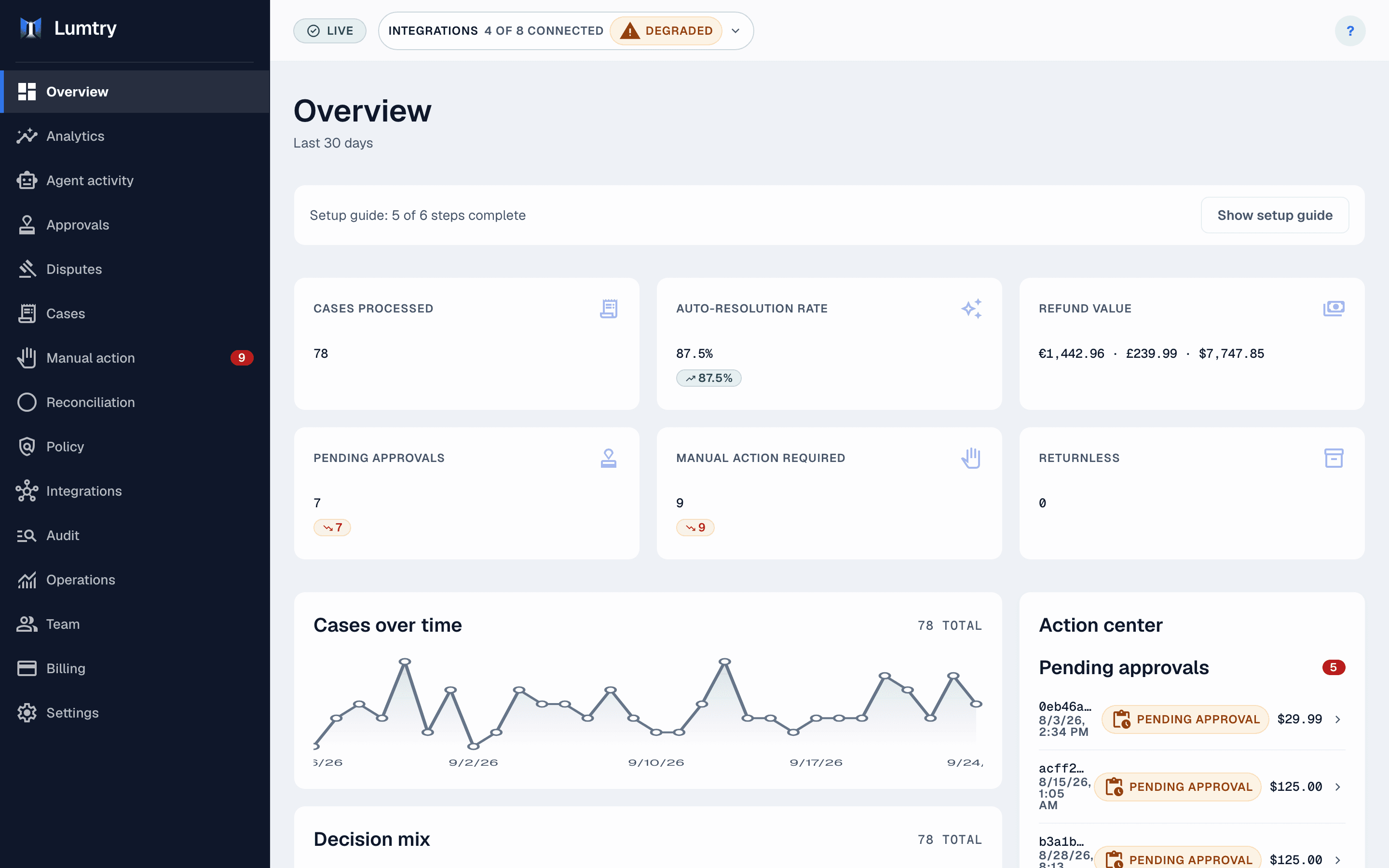
Hours saved, last 30 days
37 h
Refund leakage caught $1,840.00
Recent decisions
- #40187 · $22.50Damaged, under the auto-approve limitAuto-approved
- #40192 · $189.00Over the auto-approve limitNeeds approval
- #40203 · €64.00Outside the 30-day windowDenied
- Policy v3 pinned
- 3 signals
- Model logged
- Audit row written
Live sample
Watch three refunds get decided.
Three synthetic orders run through the same path your real ones will: policy first, a model signal beside it, a person when the rules ask for one.
Damaged
Order #38412
€64.00
Policy
Policy v3: damage rule matched
AI signal
AI rationale: matches damage policy, low risk
Outcome
Approved in Slack, refunded on Stripe
Wrong item
Order #40187
$22.50
Policy
Policy v3: wrong-item rule matched
AI signal
AI rationale: matches wrong-item policy, low risk
Outcome
Approved in Slack, refunded on PayPal
Late delivery
Order #39965
£118.00
Policy
Policy v3: over the auto-approve limit
AI signal
AI rationale: exceeds auto-approve limit, escalated
Outcome
Held for a person, approved in Slack, refunded on Stripe
Four ways refunds leak
What do you want to fix first?
Start with the problem that costs you the most. The rest runs on the same policy, approvals and audit trail.
Refund decisions
Decide every request the same way, and send the close calls to a person.
- Versioned policy with shadow mode and backtests
- AI rationale on the gray areas, never above policy
- Approvals in the dashboard, Slack, helpdesk or by voice
Returns and labels
Get the item back before the money goes out, or decide it does not need to come back.
- EasyPost and Shippo labels, QR and label-free returns
- Return-receipt gating and returnless refunds
- Shopper returns portal, ShipBob and ShipHero sync
Disputes and chargebacks
Answer chargebacks with the record you already have.
- Evidence assembled from the case record
- Narrative approved by a person before it goes out
- Deadline alerts before the response window closes
Retention and abuse
Keep the customers worth keeping, and catch the patterns worth stopping.
- Retention offers before the refund goes through
- Abuse Shield scoring and the opt-in fraud network
- Sentiment and high-risk outcome signals
How it works
Policy decides. AI advises. You stay in charge.
Every refund takes the same path. AI reads the case first and hands the policy engine signals. Your pinned policy makes the call, and a person signs off whenever the rules say so.
01
Intake
Store, marketplace and helpdesk webhooks, the returns portal or the public API.
Signature verified first
02
AI signals
Classification and sentiment run in parallel, beside abuse-risk, fraud-network and payment-hold checks.
Advisory only
Side service
Model router
Every AI call goes through one router. It is not a step in the decision.
Routing today
- Anthropic
- OpenAI
- Mistral
Not yet cleared
- xAI
Google and xAI are skipped at route time until their sub-processor review clears.
- Per-task model assignments by plan
- Automatic failover to the next vendor
- Every call logged with model, tokens and cost
- Prompt-injection screen that fails closed
03
Policy engine
Deterministic rules, first match by priority. The policy version is pinned when the case starts.
Decides
04
Outcome
One of four paths, never a guess.
- Auto-approve The rules clear it, so it executes.
- Human approval Dashboard, Slack or a voice call. The first answer wins.
- Deny A policy denial ends the run. People can deny too.
- Manual action Anything unresolved fails closed to a person.
05
Execution
Refund through Stripe or PayPal with an idempotency key.
Compensation if a step fails
06
Audit trail
Every transition is written to an append-only record with its correlation id.
Append-only
If AI is off or fails, the outcome is the same. The policy engine decides.
Policy decides, AI advises
Signals feed your rules; they never overrule them. An unavailable model cannot change a decision.
Never stuck on one vendor
Three model vendors route today, with failover between them and a weekly check for retired models.
Every step on the record
The pinned policy version, each state change and who signed off, in one audit trail.
Policy canvas
Built so you stay in control.
Your refund policy lives on a visual rule builder. Every rule is a block you can read, test and version, and nothing reaches a customer until you publish.
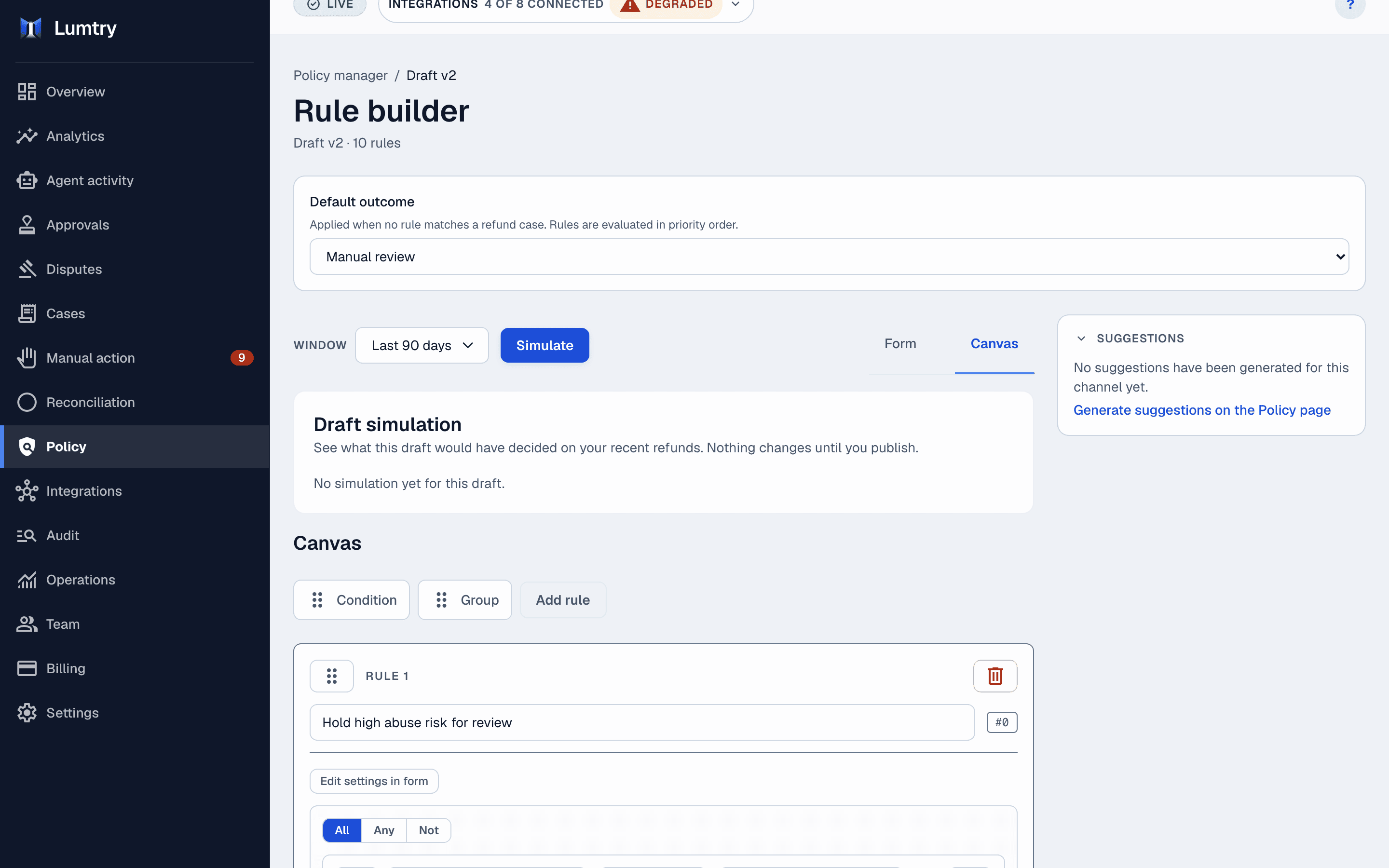
What you are looking at
- Every edit is a new versionYou work on a draft. Published versions never change, and each case stays pinned to the version it started on.
- A safe defaultWhen no rule matches, the case gets your default outcome, such as manual review. Nothing slips through unhandled.
- Rules are blocksEach rule is conditions plus one outcome. Rules run in priority order, and you drag a block to change it.
Build a rule in three steps
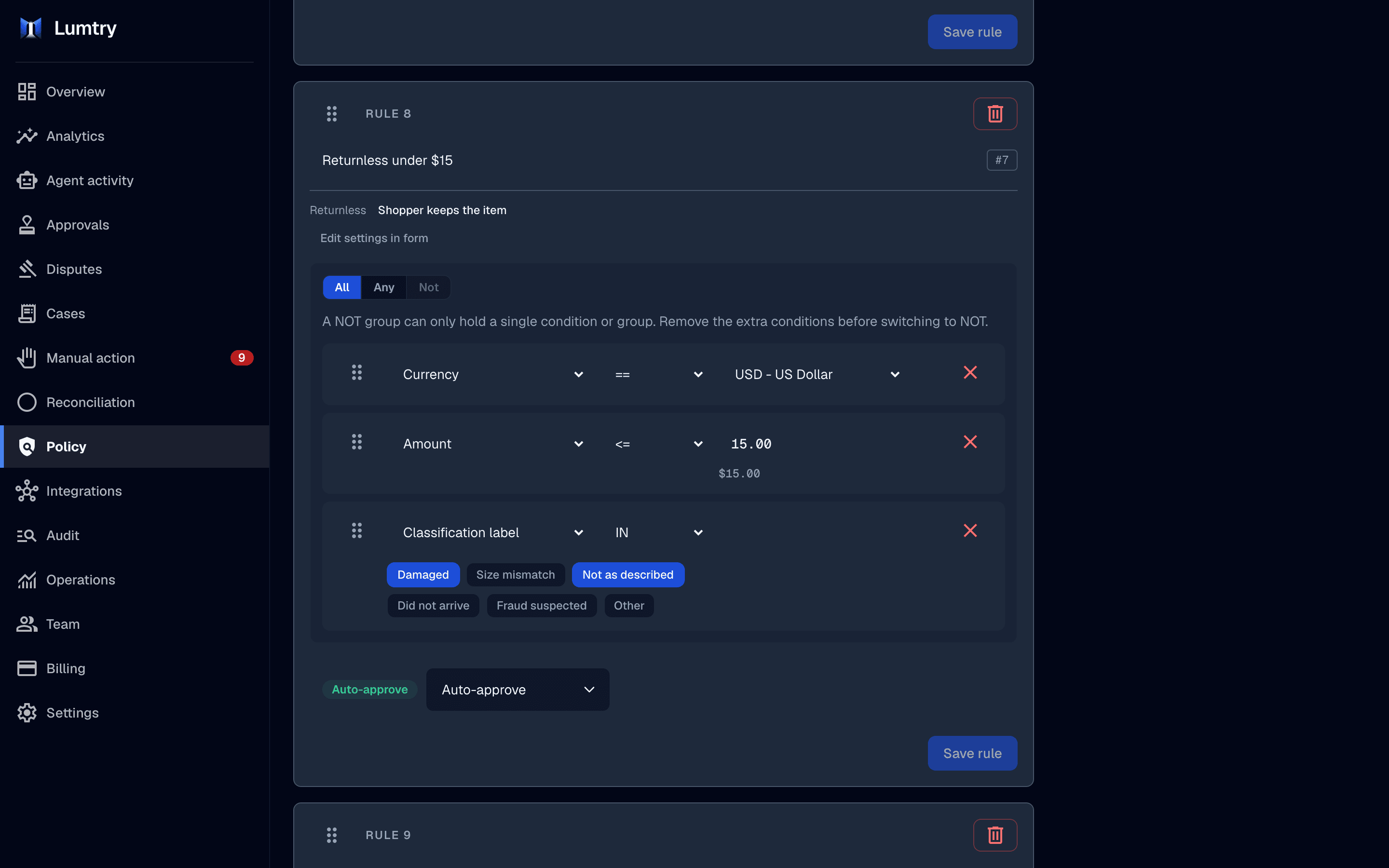
Step 1
Start from a signal
Pick what the rule looks at: abuse risk, refund reason, order age, proof of purchase and more.
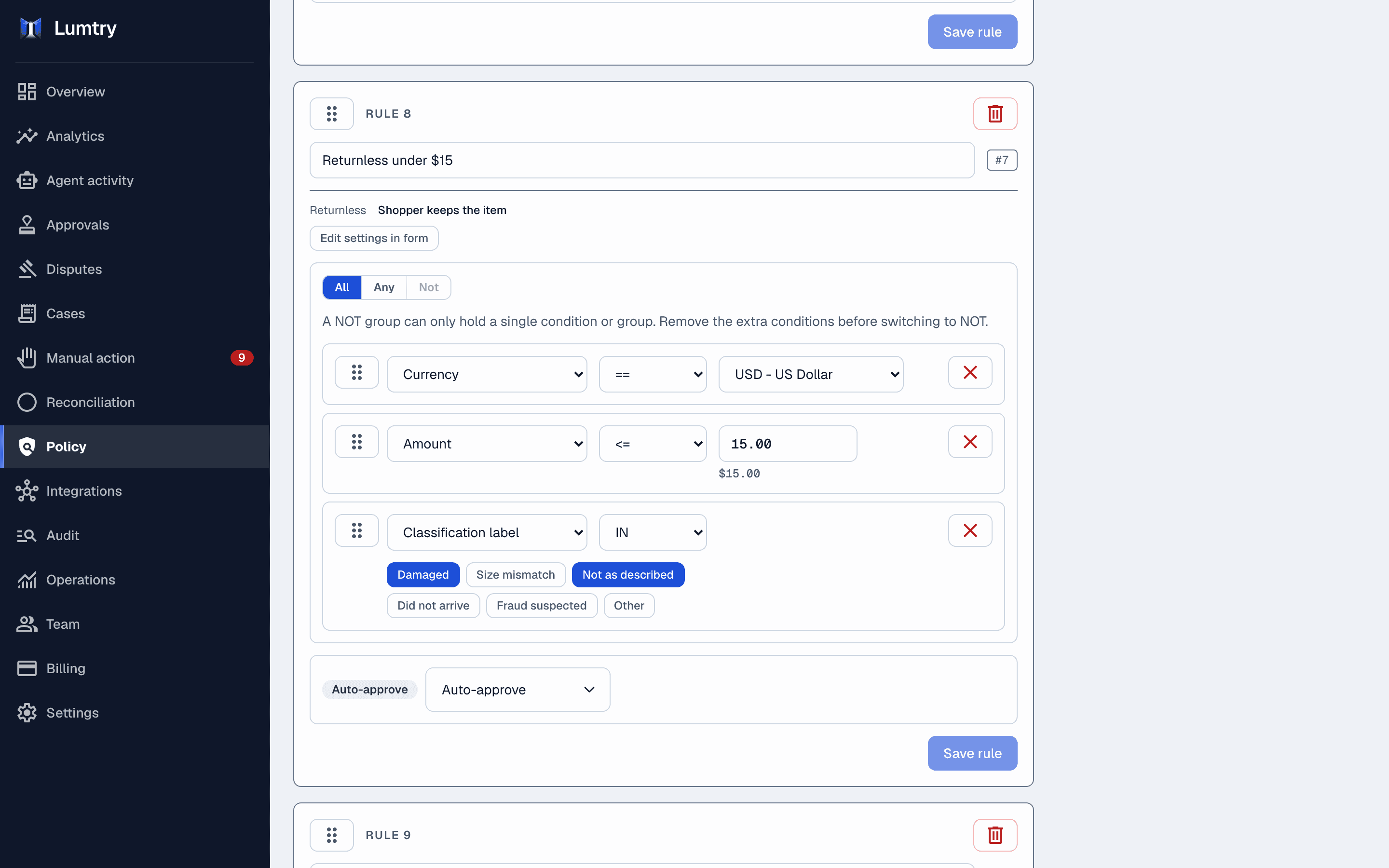
Step 2
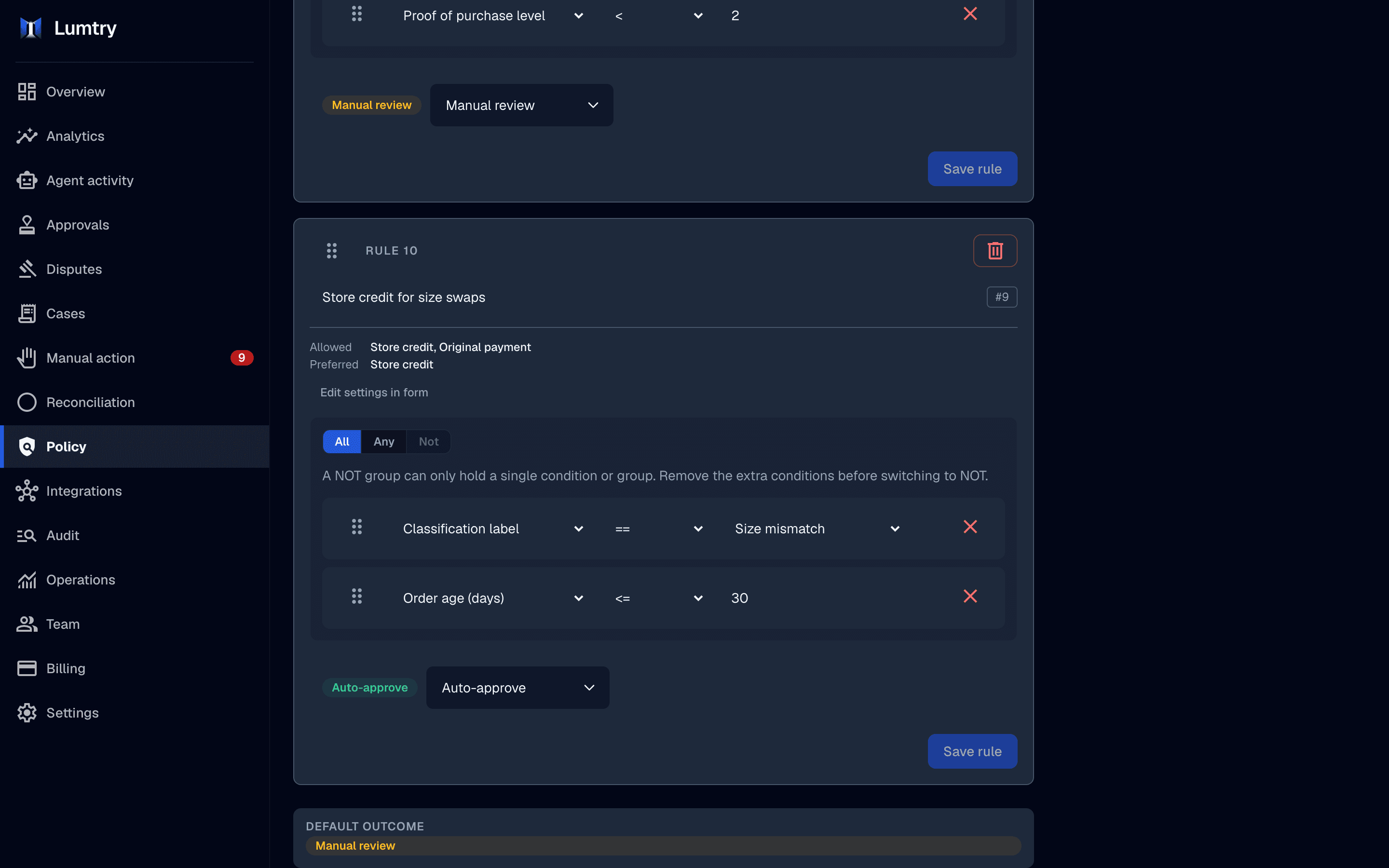
Stack the conditions
Combine amount, currency and the AI classification label with All, Any or Not.
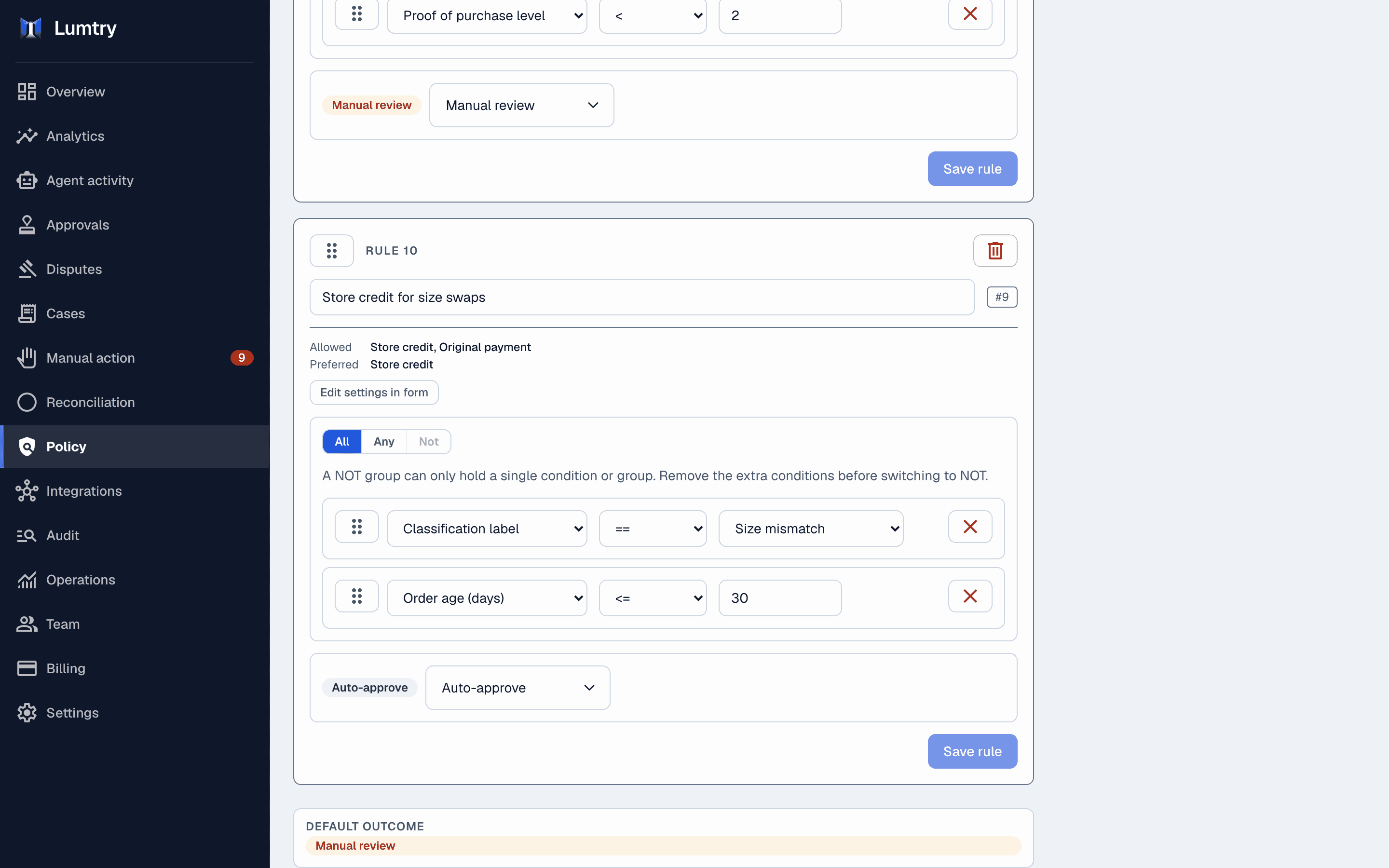
Step 3
Choose the outcome
Auto-approve, send to manual review or offer store credit first, with a default for everything else.
Approve where your team already works
Close calls go to a person. Each approval is checked against the case before anything moves.
- DashboardThe source of truth for every case.
- SlackApprove or decline from the message.
- HelpdeskGorgias and Zendesk notes on the ticket.
- VoiceAn outbound call for the urgent ones.
Reverse what already happened
Each step that moves money or stock has a matching reversal, so a failure never leaves a case half done.
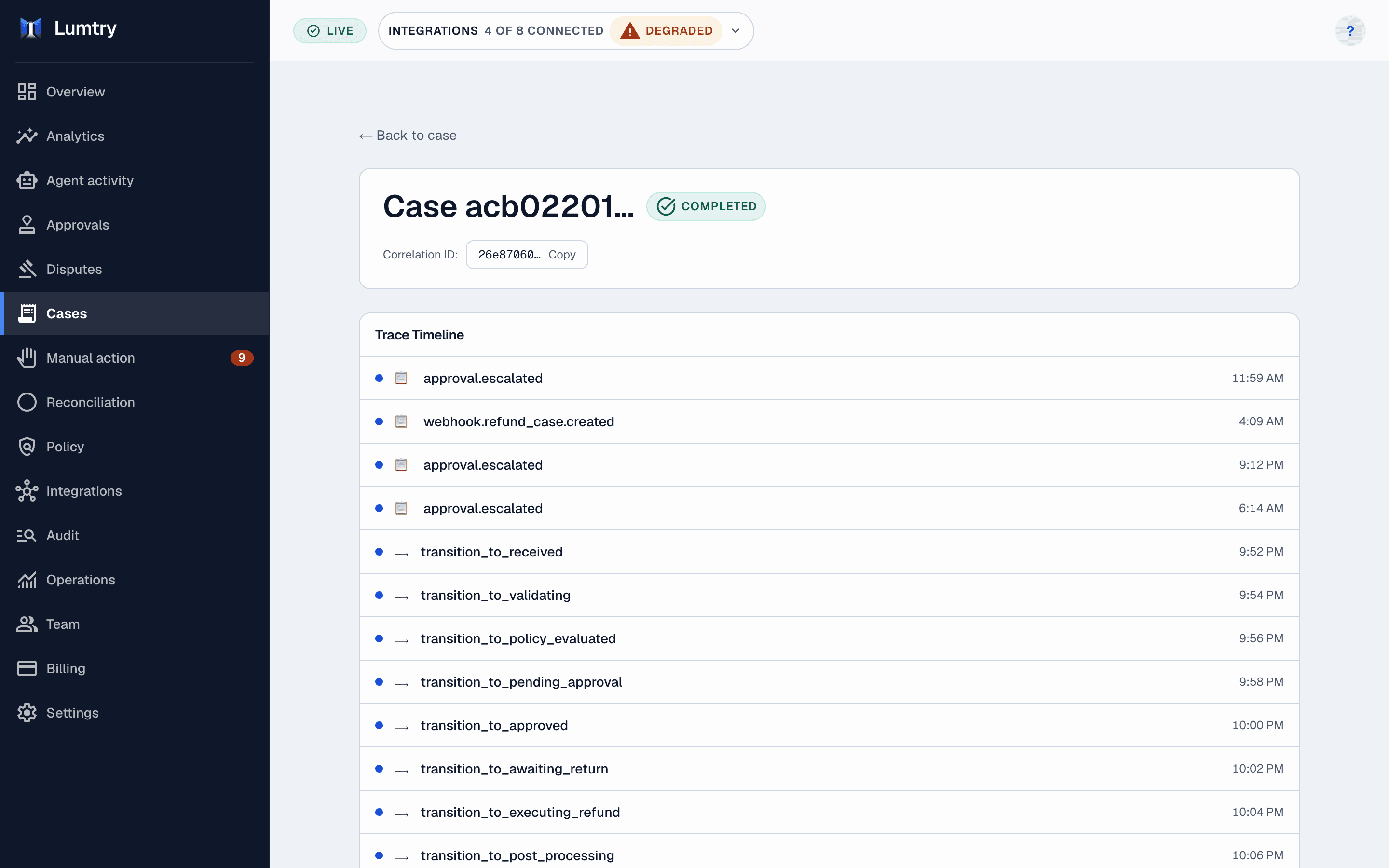
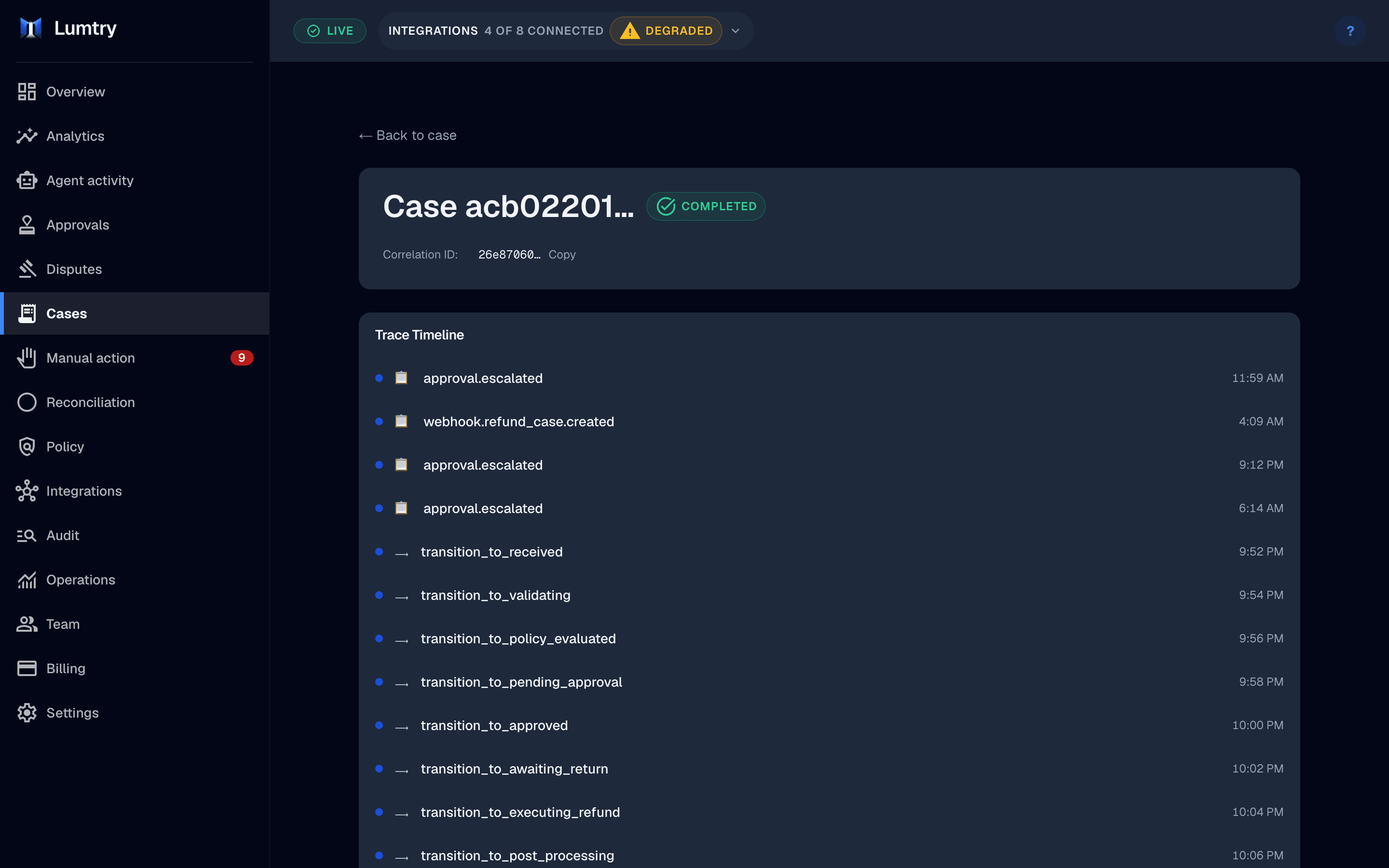
Keep an append-only record
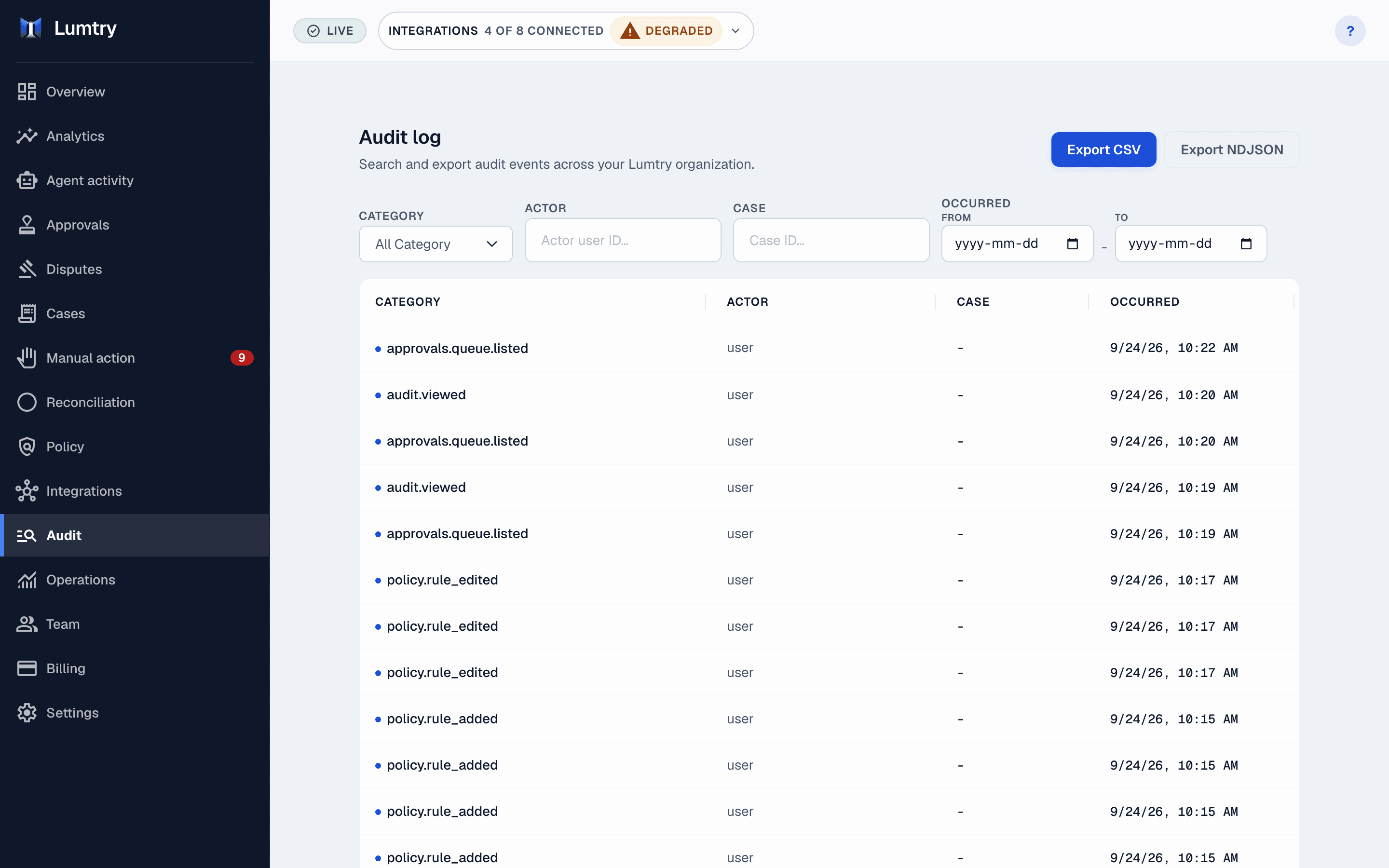
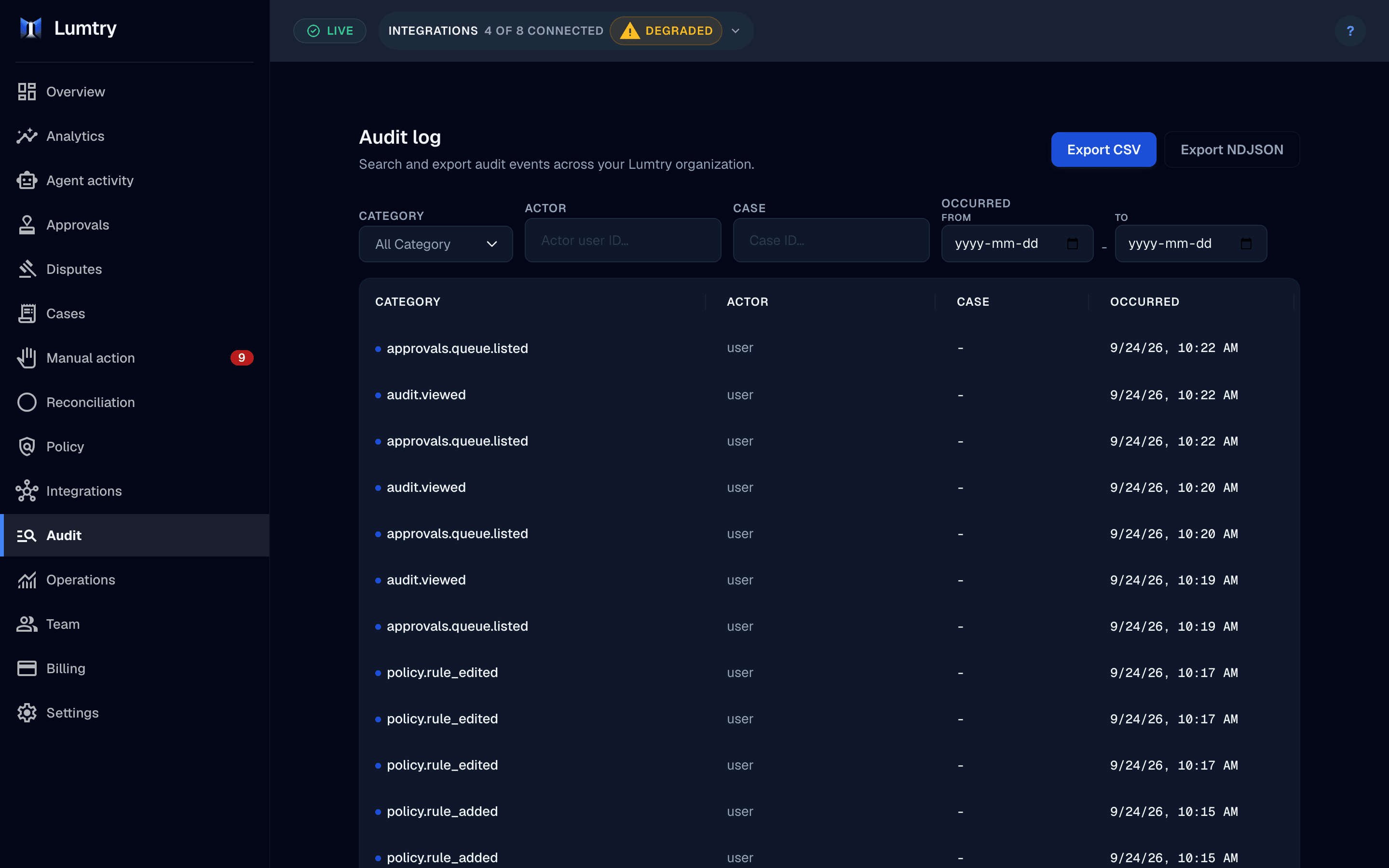
Every action writes an audit row with a correlation ID. Nobody can edit or delete it.
Automations
Works with your stack, and your AI assistant.
An MCP server for AI assistants, a public case API and signed webhooks. Same workspace, same approvals, same audit trail.
Product demo
See it on your kind of refunds.
One sample case, run live: intake, advisory AI readings, the rule that fired, and the outcome. The full sandbox lets you edit the rules.
- IntakeRC-1042 · Damaged mug · $38.00
- AI readings (advisory)Damaged in transit · 93% confidence
- Rule that firedAuto-approve threshold, version 7
- OutcomeAuto-approved, return first
Pricing
Pick the plan that fits your volume
Start on Free or a 14-day Growth trial today, no card needed. Paid plans open at launch: reserve a price and we tell you when checkout goes live.
Free
Free
Policy decisions and a dashboard to try it on real cases.
Starter
$99 a month
Slack approvals and AI rationale for a growing store.
Growth
$199 a month
More volume and more channels for a busy support team.
Scale
$499 a month
Dispute automation and Abuse Shield included.
Enterprise
Custom pricing
Custom terms, SSO and guided onboarding.
Roadmap
See what comes next
What we are building after launch. Nothing here is live today.
Next up
- ERP and accounting syncPost refunds and credits to the ledger your finance team already closes.Coming soon
- More regionsAdditional hosting regions, including Azure and managed deployment lanes.Coming soon
Further out
- Digital goodsRefund decisions for licenses, subscriptions and downloads.Planned
- Shopper receipt agentShoppers prove purchase through an assistant that proposes, never decides.Planned
- Bring your own model keyRoute AI tasks through your own provider account.Planned
- Data residency optionsChoose where case data is stored.Planned
Talk to us
Talk to the team building it
Tell us how refunds work at your store today. We read every message.
Questions
Questions, answered.
The questions merchants ask us most.
Still deciding?
Click through the sample demo, or tell us how refunds work at your store.
Platform
Does AI decide my refunds?
No. Your published policy decides. AI explains gray areas and can recommend, but a case outside the rules goes to a person.
Can I try it without connecting a store?
Yes. The demo workspace has sample cases you can click through, and the Free plan lets you set up a policy before you connect anything.
Which stores and marketplaces does it work with?
Shopify, WooCommerce and BigCommerce stores, plus Amazon and eBay marketplace intake.
Which languages does the dashboard support?
English, French (Canada) and Spanish (US).
Money and approvals
Which payment processors are supported?
Stripe and PayPal. Store credit is issued through the store platform.
What happens if a refund fails partway?
Lumtry runs the compensation for the steps already taken and flags the case, so nothing is left half done.
Can I test a new policy before it goes live?
Yes. Shadow mode runs a new policy beside the live one and shows where the outcomes differ.
Do you store card data?
No. Lumtry stores processor tokens only.
Account and billing
What happens when I hit my plan limit?
New cases are held, not dropped. They wait until you upgrade or the next period starts.
When can I buy a plan?
Checkout opens at launch. Leave your email on the pricing page and we will tell you when it does.
Do you support single sign-on?
Yes. SAML SSO, OIDC and SCIM are available on Scale.
Get started
Put policy on the volume. Keep people on the calls.
Start free, or talk to us about your refund flow.
- Free plan, no card
- 14-day Growth trial, no card
- Demo without an account